Agnikarma & Viddha Karma in Indore
Classical para-surgical therapies from the Sushruta tradition — Agnikarma (therapeutic heat) and Viddha Karma (needling) — used for localised, stubborn pain, with suitability decided honestly at consultation.
- Sushruta tradition
- For localised pain
- Suitability assessed first
Ayurveda has a rich para-surgical tradition, described in the Sushruta Samhita, that sits alongside its medicines and Panchakarma. Two of these techniques — Agnikarma and Viddha Karma — are used mainly for localised, stubborn musculoskeletal pain that has not settled with gentler measures.
Both are precise, doctor-performed procedures, not something to try casually. At Ayurveda Gokulam, Dr. Chaitanya Gupta assesses whether either is suitable for your specific problem, explains what it involves and what to realistically expect, and offers it only where it genuinely fits — candour first, always.
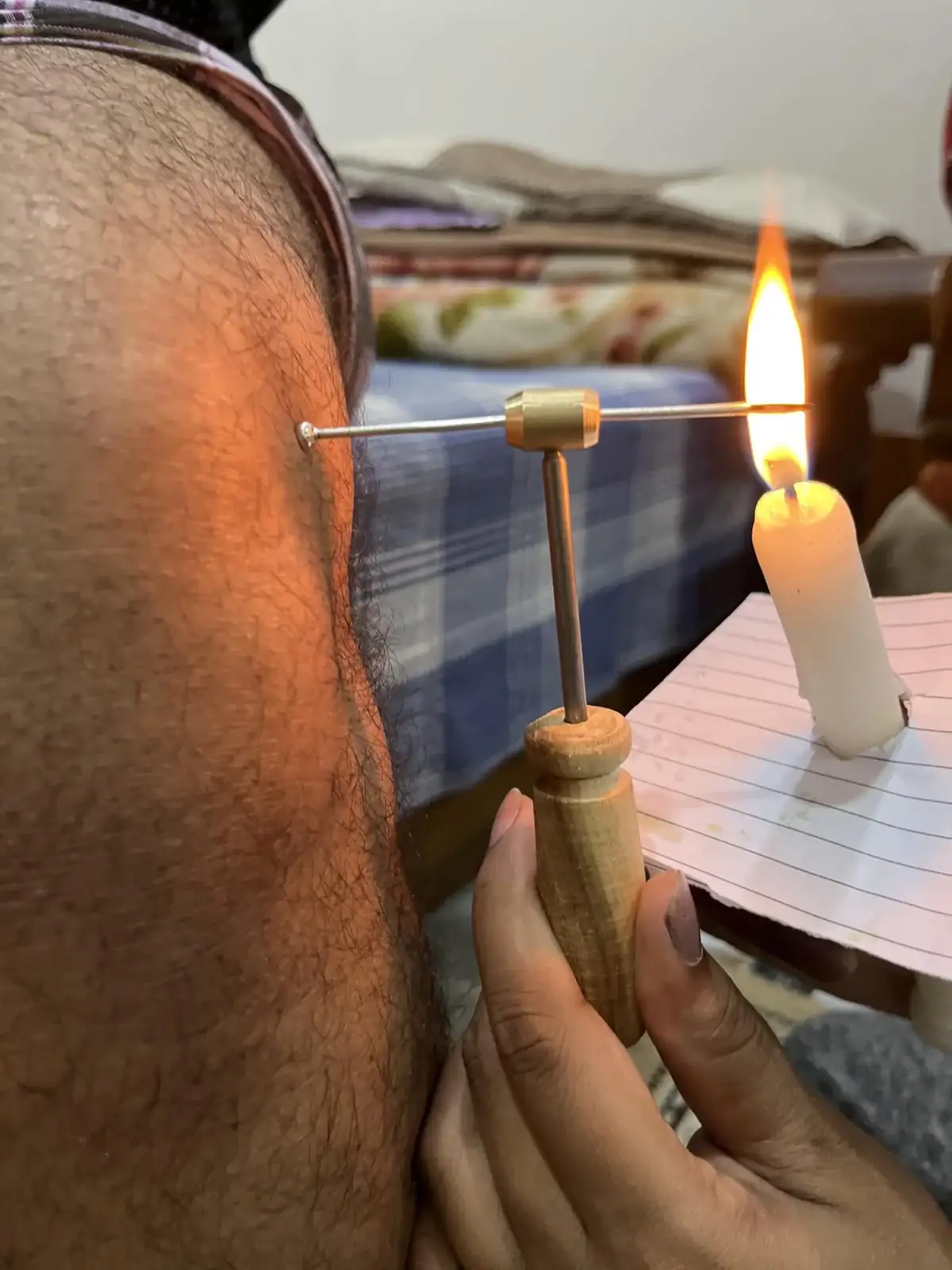
Agnikarma (therapeutic heat/cautery)
Agnikarma is the classical application of controlled, precise heat to specific points to relieve localised pain. At this clinic it is named for frozen shoulder (with Snehan and Swedan; typically 5–6 sittings in suitable cases), heel pain (with Raktamokshana; typically about 4 sittings), and as one step inside the sciatica and knee protocols — not as a stand-alone answer for every pain.
It is a quick, targeted procedure performed by the physician after examination, with simple aftercare. Suitability is decided case by case. Dr. Chaitanya Gupta will say plainly when it is not the right choice for you.
- Frozen shoulder (Apabahuka) — Agnikarma + Snehan/Swedan; typically 5–6 sittings in suitable cases
- Heel pain (Vatakantaka) — Agnikarma + Raktamokshana; typically about 4 sittings
- Sciatica / lumbar / cervical protocol — one step among Kati or Greeva Basti, Snehan–Swedan, Viddha Karma and Tikta Ksheer Matra Basti
- Knee pain / osteoarthritis protocol — one step among Janu Basti, Snehan–Swedan, Viddha Karma and Tikta Ksheer Matra Basti
Viddha Karma (therapeutic needling)
Viddha Karma is a classical needling technique applied at specific points to ease pain and improve local function. It is used for a range of musculoskeletal and some other complaints, again as a focused, doctor-performed para-surgical measure rather than a general treatment.
As with Agnikarma, the technique is precise, brief and followed by straightforward aftercare, and its suitability is judged individually after assessment. It is used for pain and local function — not as a procedure for fistula or other ano-rectal tracts, where our care is medicine-led rather than para-surgical.
The therapies behind this care
Panchakarma therapies we draw on
Which therapy or combination suits you is decided at consultation — never prescribed off a list. These are the treatments most often used for the conditions above.
Honest expectations
What this care can — and cannot — do
- Agnikarma and Viddha Karma are offered only where they genuinely suit your problem — suitability is decided by the physician after assessment, never assumed.
- They are focused para-surgical techniques for localised pain, used as part of a plan — not a stand-alone answer for every condition.
- Results are individual, and Dr. Chaitanya Gupta will tell you honestly when another approach — or a specialist opinion — is the better route.
- Both are performed with proper technique and aftercare in a clean clinical setting.
Questions, answered honestly
Frequently Asked Questions
What kind of problems are Agnikarma and Viddha Karma used for?
How many sittings for frozen shoulder or heel pain?
Can Panchakarma heal my case?
Are these procedures painful, and what is the recovery like?
How do you decide if I'm suitable for Agnikarma or Viddha Karma?
Start your healing
Book your appointment
Share a few details and we'll confirm a time on WhatsApp during clinic hours.
Consultations available in Hindi · हिंदी में परामर्श उपलब्ध है