Basti in Indore — The Cornerstone of Panchakarma
Often called the most important of the five Panchakarma actions, Basti uses medicated preparations to clear and rebuild — especially where Vata is at the root.
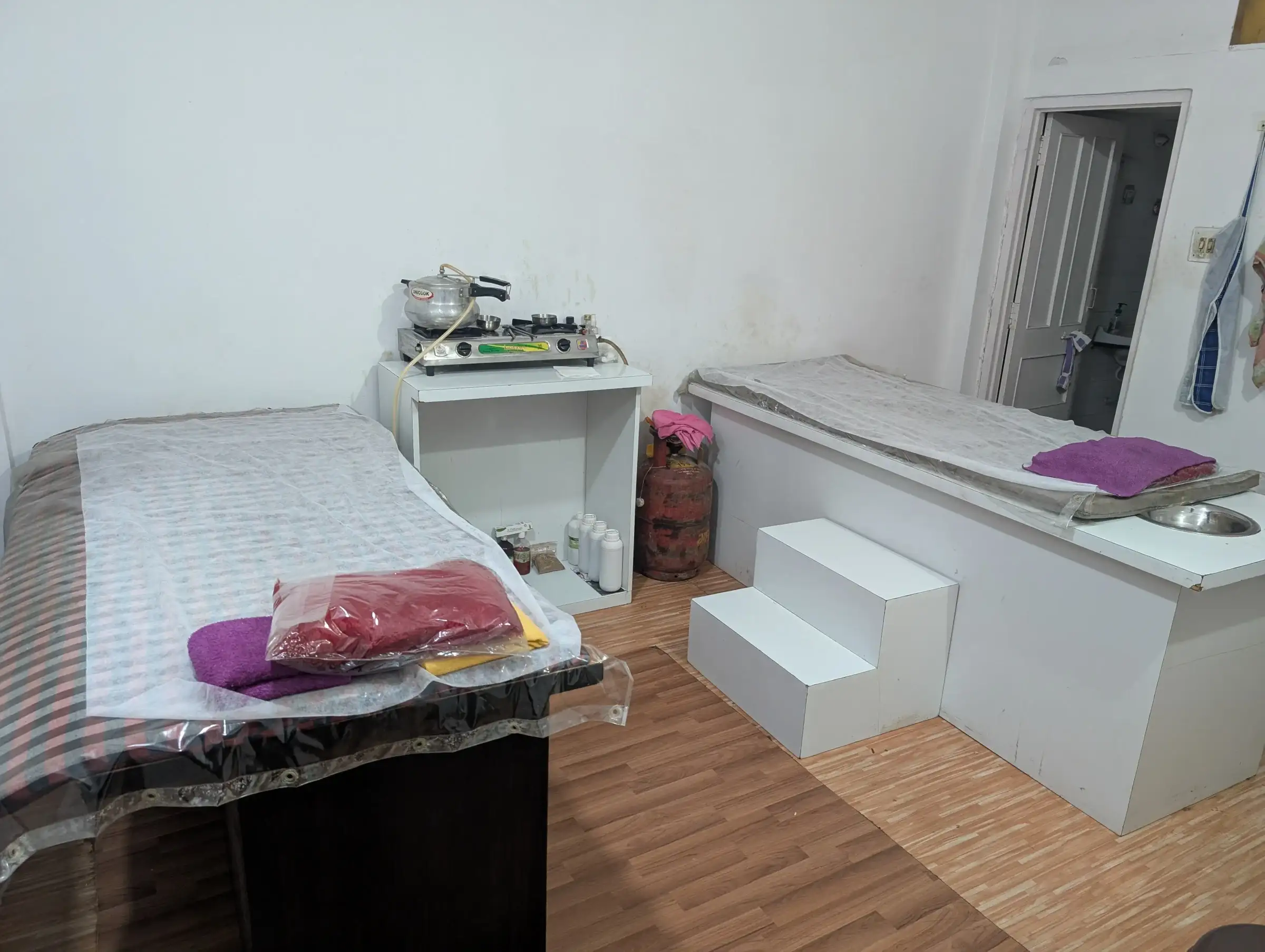
Therapy room at Ayurveda Gokulam
What is Basti?
Basti is the Ayurvedic administration of medicated oils or herbal decoctions through the rectal route. Because the colon is considered the main seat of Vata, Basti works directly where many Vata imbalances begin.
Classical Ayurveda regards Basti as the single most influential Panchakarma procedure, capable of addressing a wide range of concerns when used correctly.
This is the internal Basti family. It should not be confused with the localized oil therapies (Kati Basti, Janu Basti, Greeva Basti and similar), where warm medicated oil is simply pooled on the low back, knee or neck — those are external, comforting treatments covered on our localized oil therapies page, with dedicated pages for Kati Basti, Janu Basti and Greeva Basti. The therapies below work internally and are always chosen and supervised by the doctor.
Who it is for
Basti is chosen mainly for Vata-dominant conditions and for those needing deep, gentle clearance.
- Chronic constipation and sluggish digestion
- Joint stiffness, back pain and Vata arthritis
- Neuromuscular and lower-back concerns
- General Vata imbalance with dryness and fatigue
Niruha Basti (decoction enema)
Niruha Basti — also called Asthapana Basti — uses a herbal decoction base, often combined with oils, honey, salt and pastes. It is the cleansing, clearing form of Basti, chosen for removing accumulated Vata and toxins and for its broad therapeutic reach.
It is given only after assessment and preparation, as part of a planned course rather than a single sitting. The doctor decides whether Niruha is suitable, in what combination, and over how many days, based on your constitution and condition.
Anuvasan Basti (oil enema)
Anuvasan Basti uses a medicated-oil base and is the nourishing, lubricating form of Basti. It is gentle, well tolerated, and often alternated with Niruha Basti within a classical schedule to balance clearing with nourishment — especially valuable where dryness, depletion or Vata-type stiffness dominate.
As with all Basti, suitability, oil selection and timing are decided by the physician. It is comfortable when done properly and forms part of a supervised plan, never a one-off request.
Tikta Ksheer Matra Basti (and Matra Basti)
Matra Basti is a small, oil-based internal Basti — a measured dose, given as part of a planned course rather than a one-off request. People sometimes search it as 'matribasti'; the classical name is Matra Basti.
Tikta Ksheer Matra Basti is the form used in this clinic's spine and knee protocols: a Matra Basti prepared with tikta (bitter) medicines and ksheer (milk). It is named in the sciatica / lumbar / cervical family (alongside Kati or Greeva Basti, Snehan–Swedan, Agnikarma and Viddha Karma) and in the knee protocol (alongside Janu Basti). It is internal Basti, not Kati or Janu Basti.
Whether Matra Basti or Tikta Ksheer Matra Basti suits this case is decided on day 1. Sitting bands for those protocols remain 3–4 / 7 / 14 days for spine and often around 20 days for the knee — severity-dependent, not a package.
- Used in sciatica, lumbar pain and cervical spondylosis protocols
- Used in the knee pain / osteoarthritis protocol
- Internal medicated Basti — distinct from Kati Basti and Janu Basti
Uttar Basti (male)
Uttar Basti is a specialised medicated instillation described in classical Ayurveda for the urinary and reproductive passages. In men it is used, in carefully selected cases, as supportive care for certain urinary and urethral concerns such as recurrent infection, urethral stricture and prostate-related symptoms.
This is a discreet, doctor-only procedure: it is performed privately, with dignity, and strictly after examination — never on demand. Dr. Chaitanya Gupta decides whether it is appropriate for you, explains what it can and cannot do, and refers to a urologist when that is the better route. You can read how it fits particular conditions on our kidney stones & urinary health and men's health pages.
- Considered for recurrent UTI, urethral stricture and prostate-related symptoms in suitable cases
- Performed privately and discreetly, only after in-person assessment
- Offered as supportive care — not a replacement for urological treatment where that is needed
Uttar Basti (female)
In women, Uttar Basti is used in classical practice as a supportive medicated instillation for certain urinary and gynaecological conditions, always in carefully selected cases and after proper evaluation.
Like the male procedure, it is handled discreetly and respectfully, performed only after examination, and framed honestly. The doctor decides whether it is suitable and coordinates with specialist care when a condition needs it. Its role in urinary conditions is discussed further on our kidney stones & urinary health page, and its place in PCOS, cycle and fertility care on our women's health page.
- Considered for certain urinary and gynaecological concerns in suitable cases
- Performed privately and discreetly, only after in-person assessment
- Offered as supportive care alongside, not instead of, specialist treatment where needed
The Ayurvedic approach
A considered, step-by-step process
Basti is always preceded by proper preparation. It is never rushed or given without assessment.
- 1
Assessment & preparation (Purva Karma)
The physician confirms suitability and may advise oleation and mild warming beforehand.
- 2
Type selection
The appropriate Basti — oil-based (Anuvasana) or decoction-based (Niruha) — is chosen for your condition.
- 3
Administration
The prepared medicine is administered gently and comfortably, with the patient positioned for ease.
- 4
Retention & aftercare
Simple guidance follows on rest, diet and routine to consolidate the benefit.
Traditionally used for
Conditions this therapy is used to support
- Chronic constipation and Vata digestive issues
- Back pain and joint stiffness
- Vata-type arthritis
- Neuromuscular concerns
- Dryness, fatigue and depletion
- As a core step within Panchakarma
- Sciatica, cervical spondylosis and knee osteoarthritis protocols (Tikta Ksheer Matra Basti)
Basti is traditionally used to support these Vata-related conditions. It is delivered as part of a supervised plan, and individual results vary.
What to expect
Your visit, step by step
- Basti is usually given as a planned series rather than a single sitting.
- The procedure itself is quick and, when done properly, comfortable.
- Light diet and rest are advised on treatment days.
- Your physician will explain the schedule and what each stage is for.
Why Ayurveda Gokulam
Care you can trust in Indore
- Delivered by a registered Ayurvedic physician with correct preparation.
- Medicines and Basti type matched to your individual condition.
- Careful, dignified and hygienic administration.
- Clear scheduling and follow-up throughout the course.
Related care
Explore connected therapies & conditions
Questions, answered honestly
Frequently Asked Questions
Is Basti therapy safe?
What is the difference between Niruha and Anuvasan Basti?
What is Uttar Basti, and is it done discreetly?
How many Basti sessions are needed?
Does Basti only treat digestion?
Is Kati Basti the same as Basti (enema)?
How many sittings for sciatica or knee pain when Matra Basti is used?
Can Panchakarma heal my case?
Start your healing
Book your appointment
Share a few details and we'll confirm a time on WhatsApp during clinic hours.
Consultations available in Hindi · हिंदी में परामर्श उपलब्ध है