Ayurvedic Care for Neurological Conditions in Indore
Supportive Ayurvedic care for vertigo, trigeminal neuralgia, facial paralysis and nerve pain — led by Nasya and Panchakarma, and always alongside proper medical evaluation.
- Doctor-supervised
- Alongside your medical care
- Honest about urgency

Please read this first
New neurological symptoms need urgent medical evaluation first
Sudden facial weakness, a drooping face, sudden weakness or numbness on one side of the body, difficulty speaking, a severe sudden headache, or sudden loss of balance or vision needs urgent medical evaluation — straight away, at a hospital. Some of these can signal a stroke, where treatment is time-critical and hours matter. Please go first and ask questions later.
Ayurvedic care here supports recovery and chronic patterns after that evaluation has happened — it is not an emergency service and it is not a substitute for neurological diagnosis, imaging or treatment. Dr. Chaitanya Gupta will tell you plainly when something needs a neurologist rather than a therapy course.
Neurological symptoms are frightening precisely because they are hard to read from the outside — a spinning room, a face that will not move properly, a burning pain in a nerve. The first job is always a proper medical diagnosis, so the cause is known and anything time-critical is dealt with. Ayurvedic care comes in after that, for recovery and for the long-running patterns that medicine has done what it can for.
In Ayurveda most of these conditions are read as Vata disorders of the nervous system (Vata Vyadhi), often with local stiffness, dryness or inflammation. Care draws on Nasya, Shirodhara, Basti and warm localized-oil therapies, with internal medicines and a routine built to steady Vata. At Ayurveda Gokulam, Dr. Chaitanya Gupta assesses each case in person, coordinates with your treating doctor, and keeps the framing honest — supportive care, gradual progress, no promised outcomes.
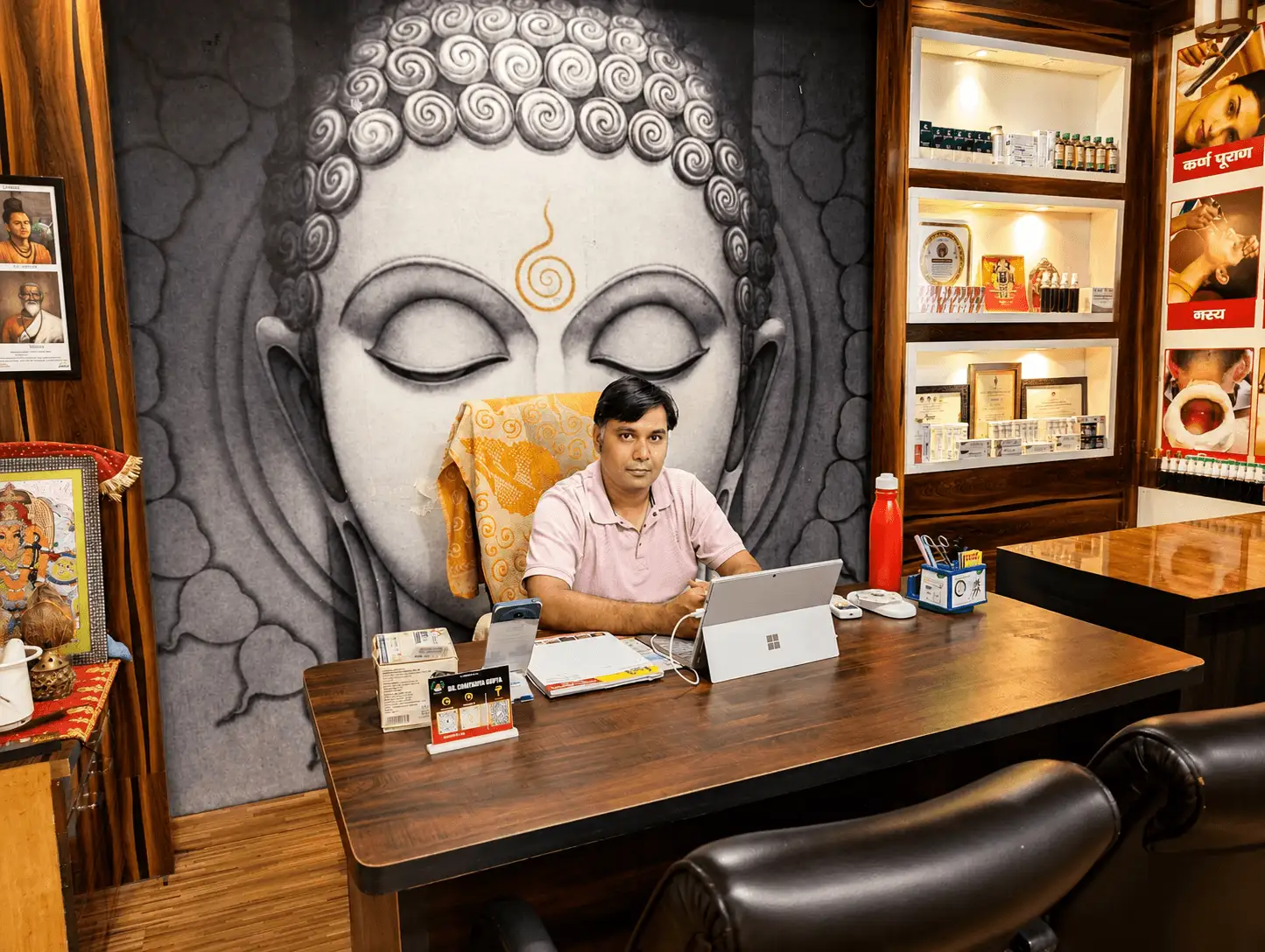
Ayurvedic care for vertigo and dizziness (Bhrama)
Vertigo is the sensation that you or the room is spinning, often with nausea, unsteadiness and a fear of turning the head or getting out of bed. The causes vary widely — inner-ear conditions, cervical spine problems, blood-pressure changes, migraine — so the picture is worth having assessed properly rather than treated blind. Ayurveda knows the presentation as Bhrama and reads it through Vata and Pitta.
Supportive care combines Nasya and Shirodhara for their calming, head-directed effect with internal medicines, and — where the neck is involved — Greeva Basti and posture correction. Diet, hydration, sleep and the avoidance of known triggers matter as much as the therapy. The aim is fewer and milder episodes and steadier day-to-day balance, not a promise that dizziness will never return.
Dizziness with sudden weakness, slurred speech, double vision, a severe headache or a fall needs urgent medical assessment first — please treat those as an emergency, not a therapy appointment.
Ayurvedic care for trigeminal neuralgia (Anantavata)
Trigeminal neuralgia brings sudden, severe, electric-shock-like pain across one side of the face — set off by something as ordinary as chewing, brushing teeth, a cold breeze or a light touch. It is genuinely one of the more distressing pains a person can have, and it needs neurological diagnosis, because both the cause and the medical treatment matter.
Classical Ayurveda describes a comparable facial pain as Anantavata and treats it as a severe Vata disorder of the head. Supportive care centres on Nasya with appropriate medicated oils, Shirodhara for its calming effect on an over-sensitised system, gentle local oil application and internal Vata-pacifying medicines. It is offered alongside your neurologist's treatment, to support comfort and reduce how often attacks are triggered — never as a replacement for the medication that is controlling the pain.
Trigeminal neuralgia is managed alongside — never instead of — your neurologist's care. Do not stop or reduce prescribed medication for it; that is a decision for your treating doctor.
Ayurvedic care for facial paralysis (Bell's palsy / Ardita)
Facial paralysis shows up as sudden weakness on one side of the face — a drooping mouth, an eye that will not close fully, difficulty smiling, whistling or holding water in the mouth. Bell's palsy is the most common form. Sudden facial weakness must be evaluated medically without delay, both because early medical treatment matters and because a stroke can look similar in the first hours.
Once that evaluation has happened, this is one of the classical indications for Ayurvedic care: Ardita is described in the classical texts, and Nasya — nasal administration of medicated oil — is its long-established therapy, supported by gentle facial oil application and fomentation, internal Vata-pacifying medicines, and simple facial exercises taught at consultation. Care supports recovery and function, works well alongside physiotherapy and your doctor's treatment, and is best begun early. Recovery is gradual and individual, and we will not promise a timeline for it.
Sudden facial weakness is a medical emergency until proven otherwise — get evaluated the same day. Ayurvedic care supports recovery afterwards; it is not the first step.
Ayurvedic care for neuropathic pain and numbness
Nerve pain has a character of its own — burning, tingling, pins and needles, numbness, or a hypersensitivity where light touch hurts — most often in the feet and hands, sometimes along a compressed nerve in the arm or leg. The causes range from long-standing blood-sugar problems and nerve compression to nutritional deficiency and the after-effects of certain treatments, so the underlying cause should be identified and managed medically.
Ayurveda treats the presentation as a Vata disorder of the nerves and tissues. Supportive care uses warm medicated-oil therapies over the affected limb, Abhyanga, Basti — the cornerstone therapy for Vata — and internal medicines, with attention to sleep, diet and the metabolic factors underneath. Where nerve compression from the spine is the driver, the spine and joint pain page covers that side of it. Continue any prescribed treatment for the underlying condition; this care sits alongside it.
The therapies behind this care
Panchakarma therapies we draw on
Which therapy or combination suits you is decided at consultation — never prescribed off a list. These are the treatments most often used for the conditions above.
Honest expectations
What this care can — and cannot — do
- Sudden facial weakness or any new neurological symptom needs urgent medical evaluation first — Ayurvedic care supports recovery and chronic patterns, it does not replace that assessment.
- This care is supportive and works alongside your neurologist or physician; we never advise stopping or reducing prescribed medication.
- Recovery from facial paralysis and improvement in nerve pain are gradual and individual — we give no timelines and promise no outcomes.
- Where a therapy is genuinely unlikely to help your case, Dr. Chaitanya Gupta will say so at consultation rather than start a course.
Questions, answered honestly
Frequently Asked Questions
Can Ayurveda help facial paralysis or Bell's palsy?
How soon after facial paralysis should Ayurvedic treatment start?
Is Ayurvedic care safe alongside my medication for trigeminal neuralgia?
What should I do if I suddenly feel dizzy with weakness or slurred speech?
Do you treat migraine and chronic headache here too?
Start your healing
Book your appointment
Share a few details and we'll confirm a time on WhatsApp during clinic hours.
Consultations available in Hindi · हिंदी में परामर्श उपलब्ध है